
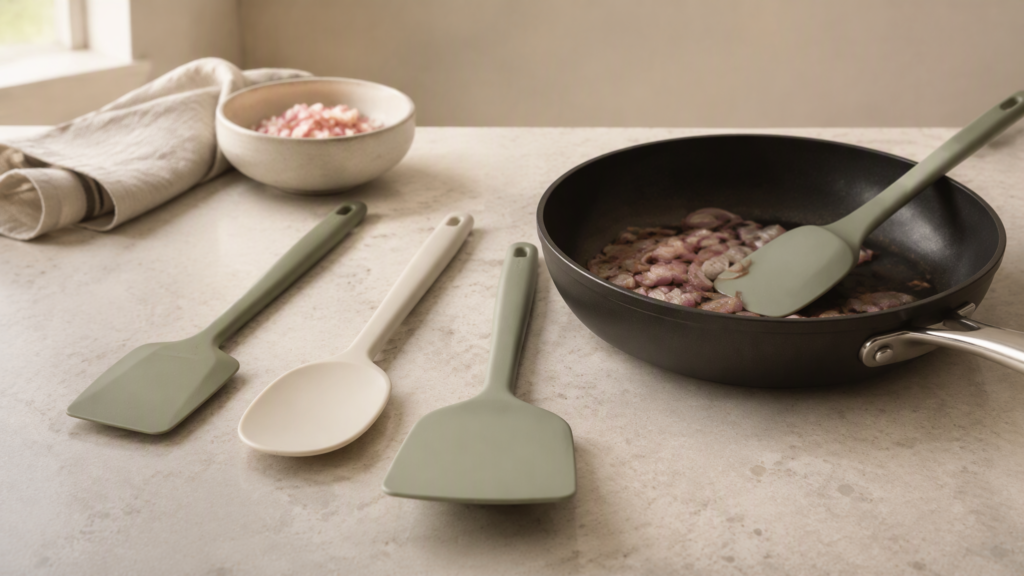
A silicone spatula is only as good as three things: the grade of the silicone, the heat rating of the whole tool rather than just the head, and how the head attaches to the handle. Most cheap spatulas fail on the second and third — the blade survives, the joint does not. This guide covers what to check before buying, what “heat resistant” actually measures, and what private-label buyers should specify at the factory.
What the term covers
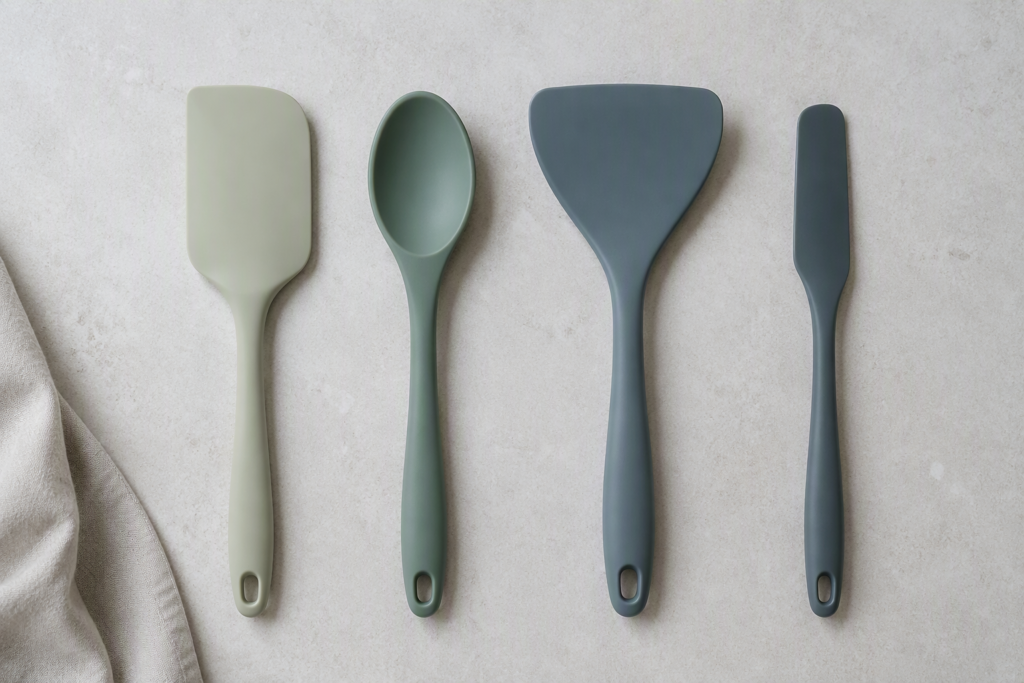
“Silicone spatula” is a family, not a single product:
- Flat scraper — thin flexible edge for bowls, pans and cake tins
- Spoonula — half spoon, half scraper; the general-purpose one
- Wok turner — wide head for tossing vegetables and noodles
- Jar spatula — narrow, curved blade for reaching into jars
- Baking set — spatula plus whisk or brush, sold as a coordinated pair
Shape decides usefulness; construction decides lifespan. A silicone spatulas and utensils range usually covers all five, and retailers do better with three complementary shapes than with one hero SKU.
The three things that decide whether it lasts
1. Heat resistance of the whole tool
Most silicone heads are rated to 230 °C (446 °F). That number applies to the silicone. It does not automatically apply to the handle or the internal core.
A spatula with a PP (polypropylene) core stiffening the blade is comfortable and rigid, but the PP softens well below the silicone’s limit. That is fine for sautéing and baking, and not fine for leaving the tool resting against a hot pan edge for ten minutes. Check where the heat rating is stated: “silicone head heat resistant to 230 °C” is an honest spec; “spatula heat resistant to 230 °C” on a tool with a plastic core is marketing.
2. One-piece versus two-piece construction
A one-piece moulded spatula has no joint, so there is nowhere for batter, oil or washing water to collect. A two-piece tool with a push-fit or screwed head is easier to clean in theory, but the gap is exactly where residue builds up and where the head eventually works loose.
For daily cooking, one-piece wins. For commercial kitchens that sanitise aggressively, one-piece also wins, because there is no crevice to fail an inspection.
3. Silicone grade
Silicone is a polymer family, not a purity standard. Cheap spatulas often blend in fillers — fumed silica or chalk — to reduce cost. The tool still feels like silicone, but it stiffens with age, cracks along the flex line, and can leave a pale mark where it bends.
The pinch test takes two seconds: twist the blade. Pure silicone returns to its original colour instantly. A white stress mark that lingers means fillers.
Which shape is best for which job
| Job | Best shape | Why |
|---|---|---|
| Scraping bowls and cake batter | Flat scraper | Thin edge follows the curve of the bowl |
| Folding egg whites, risotto | Spoonula | Wide bowl, flexible edge, gentle on structure |
| Stir-frying in a wok | Wide-head turner | Scoops and tosses in one motion |
| Non-stick pans | Any soft-edge spatula | No metal contact, no scratches |
| Jars, blenders, small tins | Jar spatula | Reaches where a flat blade cannot |
The “best silicone spatula” is therefore the one matched to your pan and your cooking style — not the one with the highest star rating. A wide wok turner is a poor batter scraper, and a thin scraper is a poor tosser. Most kitchens need two shapes, not five.
Silicone spatula heat resistance: the numbers
| Temperature | What it means in practice |
|---|---|
| −40 °C to 200 °C | Normal cooking, baking, frying, dishwasher cycles |
| 200–230 °C | Upper working range; brief contact with hot pan edges |
| Above 230 °C | Outside the material’s rating — direct flame, grill, dry hot burner |
Three practical rules follow from that table:
- Never rest a spatula on a hot burner or leave it in a dry pan on high heat. Air temperature in an empty pan climbs far faster than oil temperature.
- Silicone is not a frying thermometer. If oil is smoking heavily, the tool is near its limit even if the head has not deformed yet.
- Heat resistance is not the same as heat-proof. A 230 °C tool used at 230 °C every day will age faster than one used at 180 °C.
For non-stick pans there is a second reason to use silicone rather than metal: scratches. Research reported in 2026 found that a single scratch in a non-stick coating can release thousands of plastic particles into food, and a degraded coating far more (Economic Times, July 2026). A soft edge is the cheapest insurance against that.
Making it last
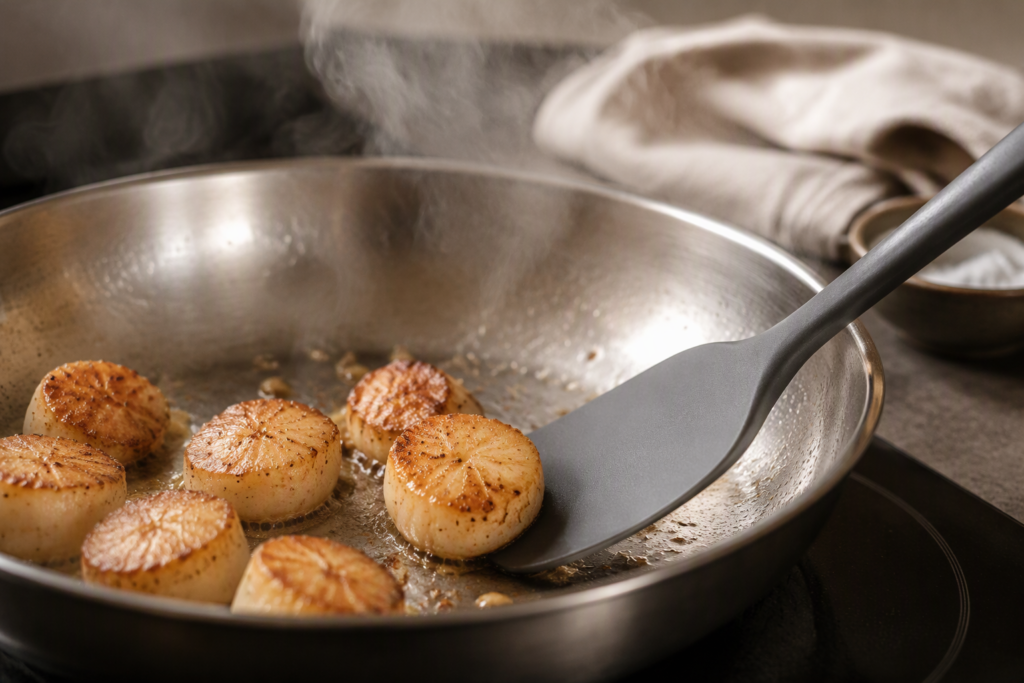
- Dishwasher is fine for silicone; heat and detergent do not degrade a properly cured head. The handle often fails first — wood should be hand-washed.
- Stained by turmeric or tomato? A paste of baking soda and water, ten minutes, then wash. Silicone is porous at the surface and absorbs strong pigments; staining is cosmetic, not a safety issue.
- Oily film after months of use is normal. Soak in hot water with baking soda, then wash.
- Store flat or hanging. Folded under a stack of pans, the flex line becomes a crack line.
- Replace at tears, a chalky surface, a loose head, or a persistent smell that soaking will not shift.
Silicone vs nylon vs wood vs metal
| Silicone | Nylon | Wood | Metal | |
|---|---|---|---|---|
| Non-stick safe | Yes | Yes | Yes | No |
| Heat ceiling | ~230 °C | Lower; softens and can scorch | Scorches | Very high |
| One-piece possible | Yes | Yes | Usually not | Yes |
| Absorbs odour | Slightly | Little | Yes | No |
| Dishwasher | Yes | Yes | No | Yes |
| Best for | Everyday, non-stick, baking | Budget sets | Serving, low heat | Stainless and cast iron |
Nylon is the closest competitor and usually cheaper, but it loses its edge — literally — faster than silicone at sustained heat. Wood is pleasant and useless in a dishwasher. Metal is for stainless and cast iron only. For a wider comparison of soft tools against rigid ones, see silicone vs plastic kitchen utensils.
From the production floor
The details that separate a spatula that survives two years of daily use from one that fails in six months are set at the mould, not at the shelf. At our Jiangmen factory, running since 2016 across 3,000 m², silicone heads are compression-moulded and then post-cured in high-temperature ovens to drive off volatiles — the step that decides whether a tool still smells of rubber after a month. Blades are deflashed by hand, because a sharp flash line on a flexible edge is where a tear starts.
Inspection runs in three stages — incoming material, in-process checks during moulding, pre-shipment audit against AQL 2.5 — and the plant holds ISO 9001 and BSCI, shipping to buyers in more than 20 countries. Material compliance is documented against FDA 21 CFR 177.2600 for repeated-use rubber articles and LFGB for the EU (eCFR). More on the process in our factory profile.
What wholesale buyers should specify
- Construction — one-piece moulded (best for retail claims) or two-piece with a replaceable head.
- Core — all-silicone blade, or PP core for rigidity. State it, because the heat claim depends on it.
- Heat rating — the number you will print on the pack, and whether it covers the handle.
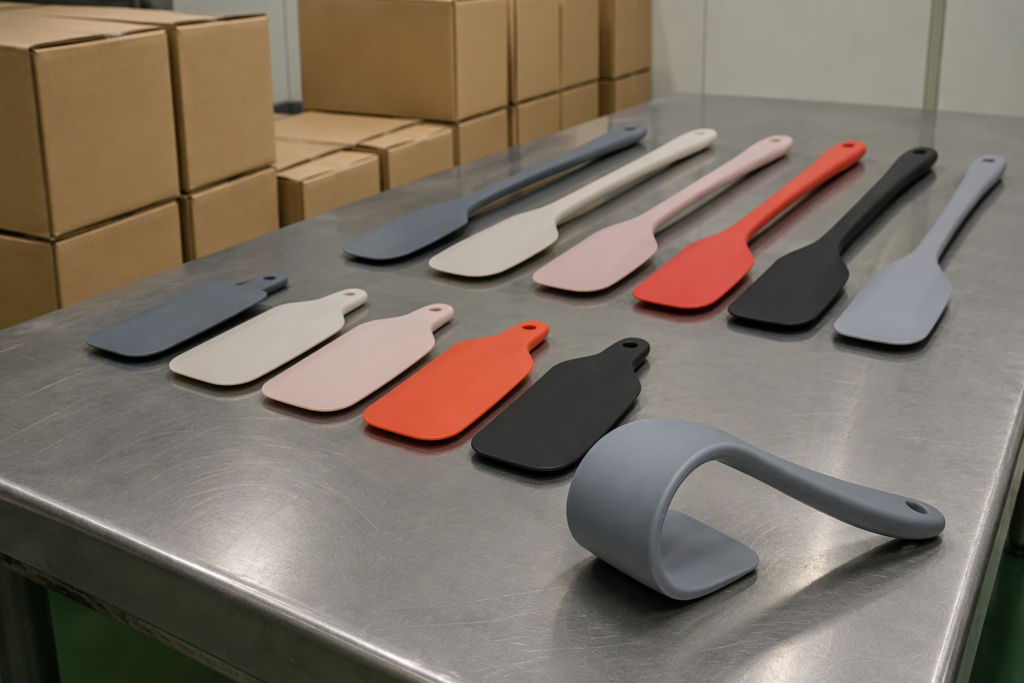
- Shape set — flat scraper, spoonula, wok turner, jar spatula, plus coordinated colourways.
- Colour — Pantone-matched, with a physical swatch approved before production.
- Logo — silk-screen, laser, or debossed into the tool. Debossed marks cannot wear off.
- Packaging — hang-tag card, printed sleeve, colour box, or FBA barcode label.
- Compliance file — FDA and LFGB test reports naming the batch.
Typical lead times: existing samples in 1–2 days, custom samples around 30 days, mass production about 15 days, with pricing tiers at 500, 1,000 and 5,000 pieces. If this is your first order, the qualification checklist in how to choose a silicone kitchenware manufacturer covers what to verify before tooling.
FAQ
Is a silicone spatula safe at high heat?
Yes, up to its stated rating — commonly 230 °C (446 °F) for the silicone head. The limit that matters in daily use is the handle and any plastic core, which soften earlier. Do not leave the tool resting on a hot burner or in a dry pan over high heat.
What is the best silicone spatula for non-stick pans?
Any spatula with a soft, fully silicone edge and no exposed metal. A wide turner suits sautéing; a flat scraper suits eggs and pancakes. The point is that nothing harder than the coating touches it.
How can I tell if a spatula is pure silicone?
Twist the blade. Pure silicone springs back to its original colour. A lingering white mark suggests fillers such as fumed silica or chalk, which stiffen and crack sooner.
Why does my spatula smell or stain?
Silicone absorbs pigments and strong aromatics at the surface. A baking-soda paste lifts most staining; a hot-water soak handles oily film. Staining is cosmetic — replace the tool at tears or a chalky surface, not at discolouration.
Is one-piece better than a removable head?
For hygiene and durability, yes — there is no gap for residue or water. Removable heads are easier to deep-clean in theory, but the joint is the first thing to loosen.
Can I put a silicone spatula in the dishwasher?
The silicone part, yes. Wood handles should be hand-washed, and two-piece tools should be checked for water trapped in the joint.
Sourcing silicone spatulas
Leeyuen makes flat scrapers, spoonulas, wide-head wok turners and baking sets in Jiangmen, with one-piece or PP-core construction, Pantone colour matching, debossed logos and retail-ready packaging. Existing samples ship in 1–2 days, custom samples in about 30 days, and bulk orders run under three-stage QC with AQL 2.5.
Send your shapes, heat rating, colour and packaging direction for a factory quotation within 12 hours. Request a wholesale quote, see the wide-head silicone wok spatula and the silicone baking spatula and whisk set, or read how to use a silicone muffin pan for the bakeware side of the same range.