
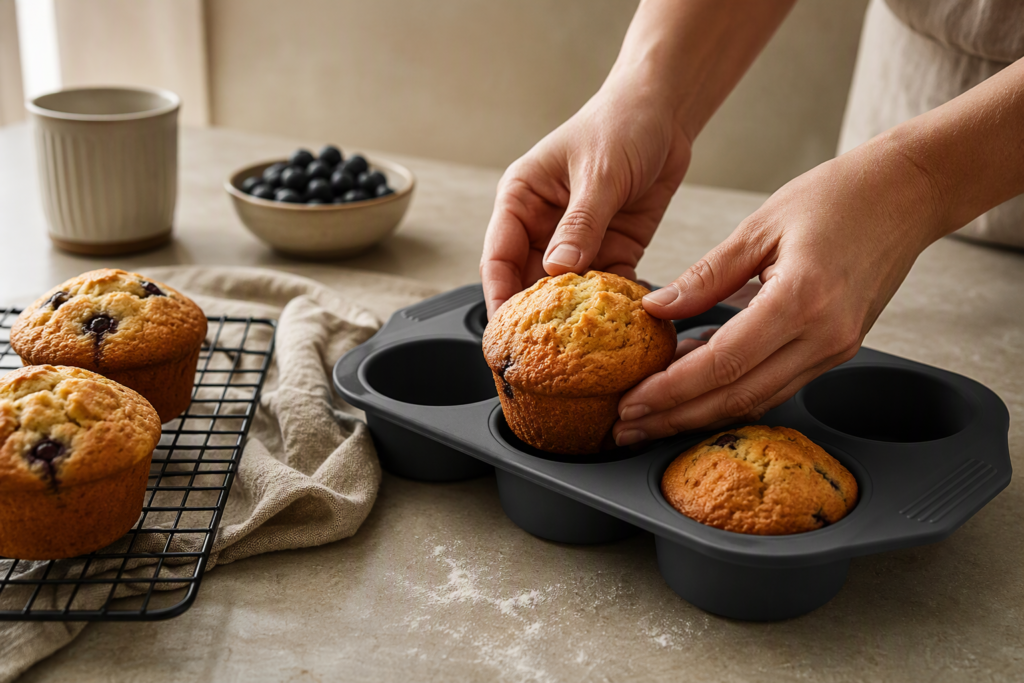
A silicone muffin pan is a flexible, food-grade silicone baking mould with fixed cup cavities, used instead of a metal tin when you want release without greasing, liners or scraping. It bakes at the same oven temperatures as metal, but behaves differently in three ways: it insulates, it flexes, and it will not brown crusts the way aluminium does. This guide covers how to use one properly, the egg-bite settings that work, what “safe” means beyond the marketing line — and what wholesale buyers should specify before ordering.
What a silicone muffin pan actually is
Most pans sold today are platinum-cured food-grade silicone — no BPA, no plasticisers, no non-stick coating to flake off. Some models, including our 6-cavity silicone muffin baking pan, add a PP (polypropylene) reinforcement rim for rigidity when a loaded pan is carried across a kitchen.
Two distinctions matter. Silicone is not “silicone-coated metal”: a coated tin is metal with a thin skin, while a silicone pan is the material through and through. And “silicone” says nothing about grade — it names a polymer family, not a purity level, which is why the pinch test below matters.
A standard pan is rated roughly −40 °C to 230 °C (−40 °F to 446 °F): freezer, oven and dishwasher, but not the broiler.
How to use it, step by step
Before the first bake
Wash in warm soapy water and dry fully. Some bakers run an empty cycle at 180 °C for ten minutes to clear residual mould-release odour, with the kitchen ventilated. A faint smell out of the box is normal and fades after one or two uses.
Setting up and filling
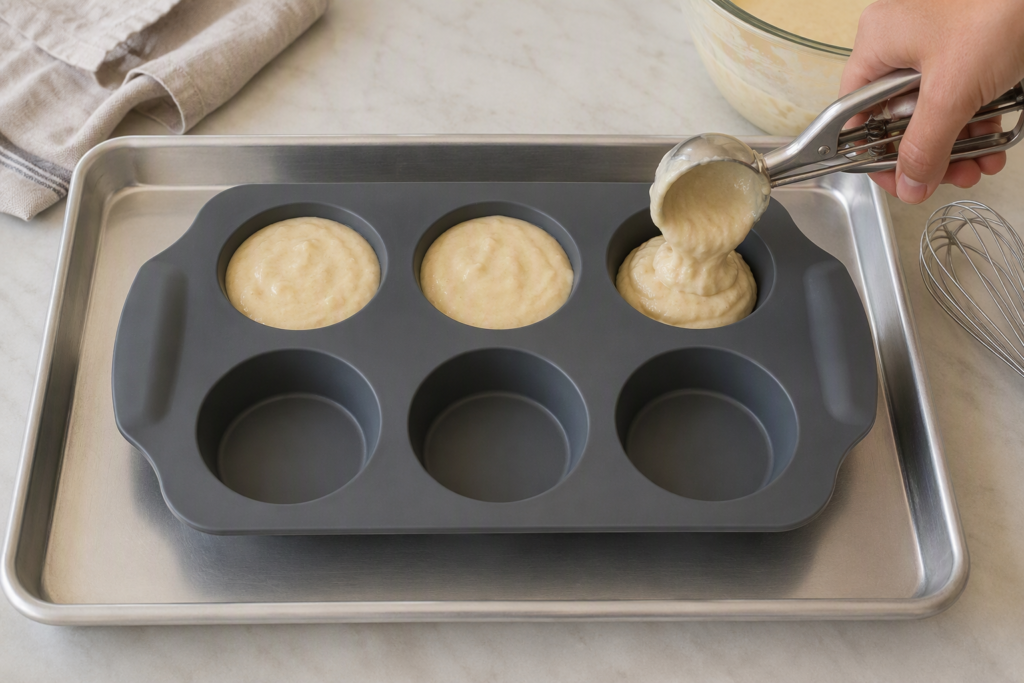
The most useful habit: set the pan on a metal baking sheet before filling it. Not for heat — a loaded silicone pan has no rigidity, and a tray stops batter sloshing on the way to the oven.
- Fill cups two-thirds to three-quarters full. Silicone walls flex outward under batter weight, so overfilled cups spread instead of rising.
- Greasing is optional for muffin and cake batters, which carry enough fat to release themselves. It is not optional for egg bites and other low-fat mixtures.
- Skip paper liners — they cancel out the reason to own a silicone pan.
Baking
Bake at the temperature your recipe specifies, typically 175–180 °C (350 °F). Silicone conducts heat more slowly than metal, so expect 5–10 minutes longer and a paler crust; finish under top heat for golden tops rather than raising the overall temperature.
Never set the pan on a gas burner, electric coil, the oven floor or under a grill. Silicone is a thermal insulator, and direct contact with a heating element concentrates heat far beyond the rated limit.
Releasing and cleaning
Rest the pan 5–10 minutes out of the oven — hot silicone tears easily and hot crumb structure collapses. Then press up from the base of each cup; the muffin lifts out whole, with no knife around the rim.
The pan is dishwasher safe. For the oily film left by butter-heavy batches, soak in hot water with a spoon of baking soda. Store flat or lightly rolled — creases under stacked pans become permanent weak points.
Silicone muffin pan for egg bites
This use case turned a niche mould into a mainstream product, and it is where most complaints originate — almost always from overbaking.
Base ratio for six cups: 6 eggs, about 120 ml (½ cup) of dairy — milk, cream, or cottage cheese blended smooth for the higher-protein version — plus salt and add-ins. Blend until uniform; unblended egg white sets rubbery.
| Method | Temperature | Time | Notes |
|---|---|---|---|
| Oven, water bath | 160–165 °C (325 °F) | 22–28 min | Softest custard; pour hot water into the tray around the mould |
| Oven, dry | 175 °C (350 °F) | 18–22 min | Faster, slightly firmer edges |
| Air fryer | 150–160 °C (300–320 °F) | 10–14 min | Cover loosely with foil so the top does not set first |

Pull them when the centres still wobble slightly — they finish setting during the rest. Fill three-quarters, brush the cups lightly with oil, and rest 3–5 minutes before pressing them out.
The same pan handles mini frittatas, crustless quiches, frozen herb-and-oil cubes and chocolate cups — which is why retail buyers list it as a multi-use mould, not a muffin tin.
Silicone muffin pan safety: what to actually check
“Safe” is not a yes-or-no property of the word silicone — it is a function of grade, cure and use.
1. Purity — the pinch test. Twist the wall of an empty cup. Pure silicone flexes and returns to its original colour; a white stress mark that lingers suggests fillers — fumed silica or chalk used to cut cost. Filled silicone still bakes, but stiffens with age and cracks at fold lines.
2. Regulatory compliance. For food-contact silicone sold into Western markets, the reference points are FDA 21 CFR 177.2600 for repeated-use rubber articles in the US, and LFGB §30/§31 with BfR Recommendation XV in Germany and much of the EU. Ask for test reports naming the regulation and the batch — “FDA approved” without a standard reference is not evidence.
3. Temperature discipline. A 230 °C rating is a ceiling, not a target — baking sits below it, broiling does not. Note that “BPA-free” is meaningful for the PP frame, not the silicone itself; a detail worth getting right in your own product copy.
4. The PFAS angle. Silicone bakeware carries no applied non-stick coating, so the fluoropolymer question now dominating non-stick cookware regulation barely applies. That is increasingly a selling point: several US states restrict PFAS in cookware, with Maine and Colorado bans effective January 2026 (EWG, July 2026). Demand is following — the global bakeware market is projected to reach USD 7.87 billion by 2034 from about USD 4.72 billion in 2026 (Fortune Business Insights, September 2026).
5. When to replace it. Retire the pan at tears around the cup base, a chalky or tacky surface washing will not fix, or odour that survives a baking-soda soak. Silicone absorbs strong aromatics over years — a material limitation, not a defect.
Silicone vs metal muffin pans
| Silicone | Metal (aluminium / steel) | |
|---|---|---|
| Release | Press from base, no greasing | Needs grease, flour or liners |
| Browning | Paler, softer crust | Golden, crisp edges |
| Stability | Needs a baking sheet underneath | Self-supporting |
| Storage | Collapses flat | Fixed volume |
| Cleaning | Dishwasher safe | Hand-wash corners, coating wears |
| Coating risk | None | Non-stick layers can scratch and flake |
| Best for | Egg bites, custard, delicate bakes, small kitchens | Crusty muffins, high-volume baking |
Neither wins outright. If your range strategy is “healthy meal prep and multi-use,” silicone is the hero product; if it is “bakery-style crust,” metal still leads. The same logic runs across the category — see our comparison of silicone vs plastic kitchen utensils.
From the production floor
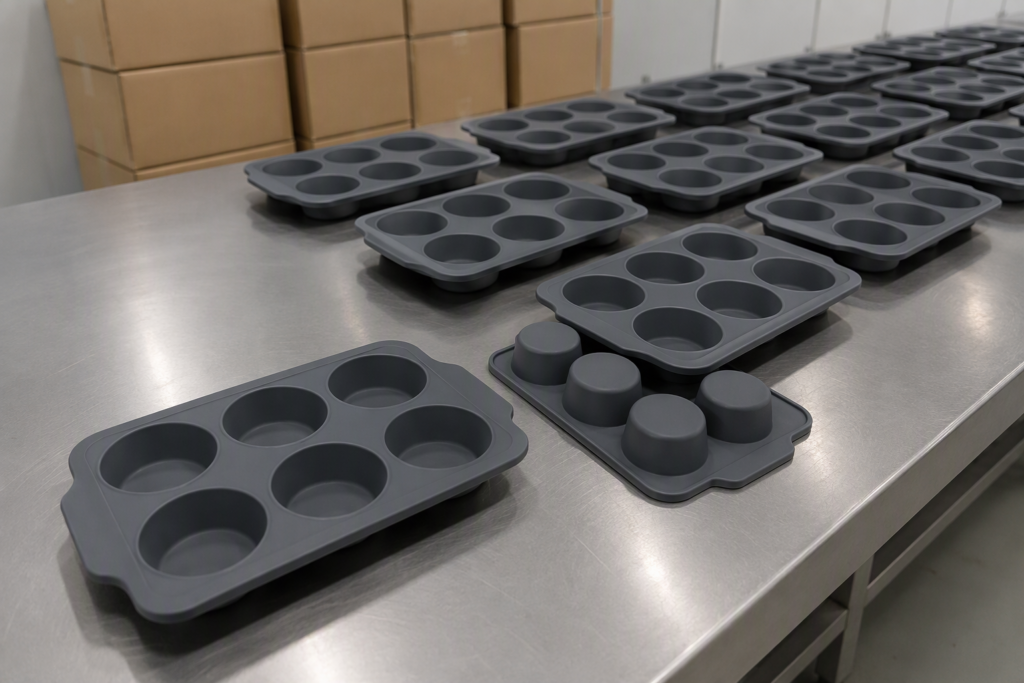
Whether a mould survives a dishwasher cycle in Ohio or a freezer in Norway is decided long before packing. At our Jiangmen factory, running since 2016 across 3,000 m², silicone bodies are formed on hydraulic compression presses and post-cured in high-temperature ovens to drive off volatiles — the step most responsible for a pan that does not smell after three months. Cup rims are deflashed by hand, because a sharp edge is the first thing a buyer notices on a shelf.
Inspection runs in three stages: incoming material, in-process checks during moulding, and a pre-shipment audit against AQL 2.5. The plant holds ISO 9001 and BSCI and ships to buyers in more than 20 countries, documentation included — an FDA or LFGB claim without paperwork is a liability, not an asset. More in our factory profile.
What wholesale buyers should specify
Pin these down before requesting quotes:
- Cavity count — 6, 12 or 24. Six is the retail and Amazon FBA standard; 12 and 24 suit food service and club-store packs.
- Cup geometry — standard muffin (about 70 mm), jumbo, or shallow egg-bite cups. Depth drives both yield and carton size.
- Frame or no frame — a PP rim reads as more rigid; all-silicone collapses flatter for storage.
- Colour — matched to a Pantone reference, swatch approved before mass production.
- Logo method — silk-screen, laser, or debossed into the mould tool. Tool-debossed marks cannot wear off.
- Packaging — colour box, printed sleeve or polybag with warning label, plus FBA barcode placement.
- Compliance file — test reports for the destination market, not a generic certificate.
Typical lead times: existing-sample evaluation in 1–2 days, custom samples around 30 days, with pricing tiers at 500, 1,000 and 5,000 pieces. For a first order from a Chinese supplier, the audit checklist in how to choose a silicone kitchenware manufacturer covers what to verify before committing to tooling.
FAQ
Is a silicone muffin pan safe to bake in?
Yes, provided it is 100% food-grade silicone rated for oven use — typically up to 230 °C (446 °F). Safety depends on grade rather than the material name, so ask for FDA 21 CFR 177.2600 or LFGB test reports covering the specific batch.
Why did my muffins take longer than the recipe said?
Silicone conducts heat more slowly than metal. Add 5–10 minutes and expect a paler crust. If timing is far off, check that the pan is on a metal baking sheet and that the oven is actually at temperature.
Do I need to grease a silicone muffin pan?
Not for muffin or cake batter — the fat in the recipe releases on its own. Do grease the cups for egg bites, frittatas and other low-fat mixtures, where protein binds to the wall.
Can I use it in an air fryer?
Yes, if the pan fits with clearance for airflow. Use 150–160 °C and cover loosely with foil so the tops do not set before the centres. Never let the silicone touch the heating element.
How do I get rid of the oily film?
Soak in hot water with baking soda for 30 minutes, then wash as normal. Avoid abrasive scouring pads, which dull the surface and make future sticking worse.
Is silicone better than metal for a private-label range?
It is better for differentiation: multi-use positioning, no coating claims to defend, lighter freight, and strong appeal in the meal-prep segment. Metal still wins on crust browning. Most successful ranges carry both.
Sourcing silicone muffin pans
Leeyuen manufactures 6, 12 and 24-cavity silicone muffin pans in Jiangmen, with custom cup geometry, Pantone colour matching, tool-debossed logos and retail-ready packaging. Existing samples ship in 1–2 days, custom samples in about 30 days, and bulk orders run under three-stage QC with AQL 2.5 and full export documentation.
Send your cavity count, cup size, colour and packaging direction for a factory quotation within 12 hours. Request a wholesale quote, or browse the silicone baking molds and tools range and the full kitchenware range.