
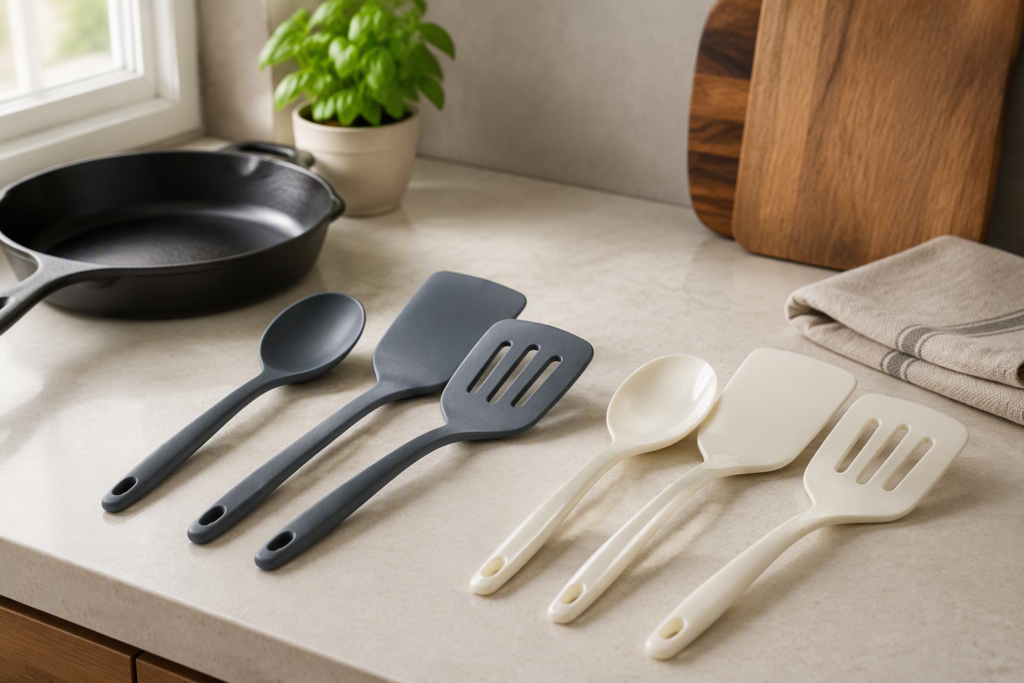
For anything that touches hot food or a non-stick surface, silicone wins. Food-grade silicone is rated from −40°C to 230°C, is chemically inert, does not leach into food, and will not scratch coated pans. Plastic (mainly PP) is cheaper and firmer, which makes it fine for cold prep, budget lines, and stiff tasks — but it softens at high heat and can degrade with friction. The practical rule: silicone for heat and non-stick; PP for cold prep and price-sensitive ranges.
What most buyers miss about this comparison
After years of producing both materials under one roof, the honest answer is that “silicone vs plastic” is the wrong question. The real question is which grade, for which job, at which price tier.
A budget PP turner and a platinum-cured silicone turner are not competitors — they are two different products serving two different shoppers, and a strong kitchen line usually carries both. Where buyers get into trouble is treating “silicone” or “plastic” as a single material, when within each category the grade determines heat performance, safety, and cost far more than the category name does.
From the production floor: the most common quality failure we see in low-cost kitchen tools is not “wrong material” — it is undeclared filler in what is sold as silicone, or non-food-grade resin in what is sold as a plastic utensil. Both look fine on a purchase order and only show up at the customer.
Head-to-head comparison
| Feature | Silicone | Plastic (PP / nylon) |
|---|---|---|
| Heat resistance | −40°C to 230°C (−40°F to 446°F); stable near its limit | PP: continuous use to ~110°C (230°F), melts at 160–170°C; nylon resists more heat but softens on the stovetop |
| Food-contact safety | Chemically inert, no leaching, BPA-free by nature | Food-grade grades are safe; low-grade or heat-degraded plastic can migrate substances |
| Non-stick cookware | Safe — flexible, non-scratch | Rigid edges can scratch coated pans |
| Flexibility | Flexible, conforms to the pan | Rigid (PP) or semi-flexible (nylon) |
| Durability | Long-lasting, resists cracking, staining and odor | Can warp, craze or discolor with heat |
| Cleaning | Dishwasher-safe, non-porous, releases food easily | Dishwasher-safe; can stain or absorb oils over time |
| Cost | Higher material cost | Lower material cost |
| Sustainability | Not biodegradable, but inert and very durable; limited recycling | Recyclable (PP #5); can shed microplastics as it wears |
Heat resistance: where silicone wins clearly
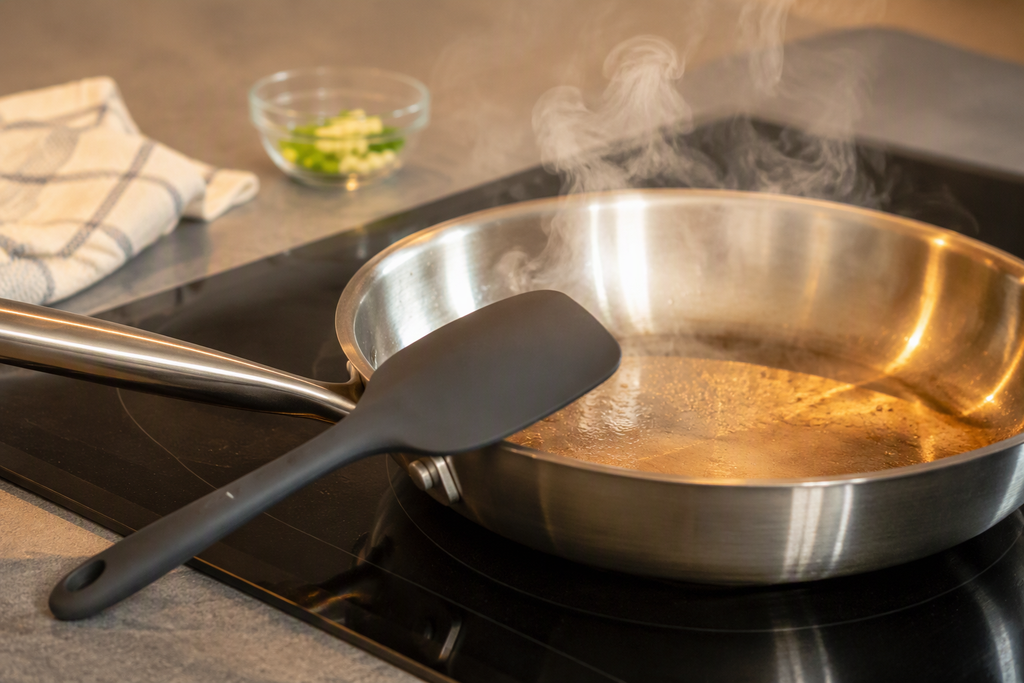
- Silicone is rated to 230°C (446°F) for continuous food-contact use, and some grades reach 260°C (500°F). It also stays stable well below its limit, so it does not creep toward failure during normal cooking.
- Polypropylene (PP) holds up to roughly 110°C (230°F) continuously and melts between 160°C and 170°C (320–340°F). That covers hot drinks and microwave reheating, but a PP spatula left in a hot pan is asking for trouble.
- Nylon resists more heat than PP, but it still softens on the stovetop at medium heat and can deform or leave marks on the pan.
From the production floor: how a silicone is cured matters as much as its material. Peroxide-cured silicone is the cheaper route and is common in basic FDA-grade goods; platinum-cured silicone carries no curing by-products, which is why it is the standard for LFGB-grade, odor-free, high-heat tools. If a supplier cannot tell you which curing method they use, treat the “food-grade” claim as unverified.
Food safety: BPA, leaching and fillers
Both materials can be perfectly safe — if the grade is right.
- Silicone has a silicon–oxygen backbone that makes it chemically inert. It does not react with food, does not leach, and is naturally BPA-free (BPA belongs to a different polymer family, polycarbonate). It is also non-porous, so it does not harbor bacteria.
- Plastic safety depends entirely on the resin. PP (polypropylene) and food-grade nylon are safe for food contact. Materials to avoid are polycarbonate (which can contain BPA) and any heat-degraded or low-grade plastic.
- The hidden risk in “silicone”: cheap silicone can be cut with plastic fillers. Filled silicone not only behaves worse at heat, it can leach.
For the US market, silicone for repeat food contact falls under FDA 21 CFR 177.2600; for the EU/German market, the equivalent benchmark is the BfR Recommendation XV for silicones under LFGB. Always request a third-party test report on the exact grade used for your order — not a self-declared certificate.
The field test you can run on a sample — the pinch/twist test: twist the silicone tool between your fingers. Pure food-grade silicone holds its color; filled silicone turns white at the stress point. Cheap filler also shows up as a chemical odor on a new product or a waxy “bloom” over time.
Durability and cooking performance
| Task | Silicone | Plastic |
|---|---|---|
| Flipping in a hot non-stick pan | Ideal — flexible, non-scratch | Rigid edges risk scratching the coating |
| Scraping a pan or bowl clean | Conforms and reaches edges | Firm edge scrapes well, but stiff |
| Stirring thick mixtures | Easy, won’t snap | Rigid handle gives good leverage |
| High-heat searing / grilling | Stable to 230°C+ | Softens and can deform |
| Cold prep, mixing, storage | Good | Excellent value |
Silicone’s flexibility is also a durability advantage: it will not crack, snap, or permanently deform, and it resists staining and odor pickup better than plastic over a long service life.
Cleaning, staining and hygiene
- Silicone is non-porous and non-stick, so food releases easily; it is dishwasher-safe and resists absorbing oils, colors and smells.
- Plastic is dishwasher-safe too, but over time PP can pick up stains from turmeric, tomato and oil, and micro-scratches from cleaning give residue somewhere to cling.
If easy cleaning and long-term hygiene matter to your end users, silicone has the edge — and it makes for a stronger “easy-care” retail claim.
Cost and sustainability
Cost: Plastic is the cheaper material, so a PP utensil hits a lower price point and delivers higher unit margin at the budget end. Silicone costs more per piece, but its durability and premium feel support a higher retail price — which is why silicone ranges sit in the mid-to-premium tier.
Sustainability: Neither material is biodegradable, but they behave differently:
- Silicone is chemically inert and extremely durable, so it does not shed microplastics as it wears and lasts for years.
- PP is technically recyclable (#5), but it can shed microplastics as it degrades with heat and friction.
For eco-positioned lines, emphasize durability and long service life — the strongest honest claim for silicone — rather than “biodegradable,” which would be inaccurate for both materials.
Which material for which job
| Product / use case | Recommended material |
|---|---|
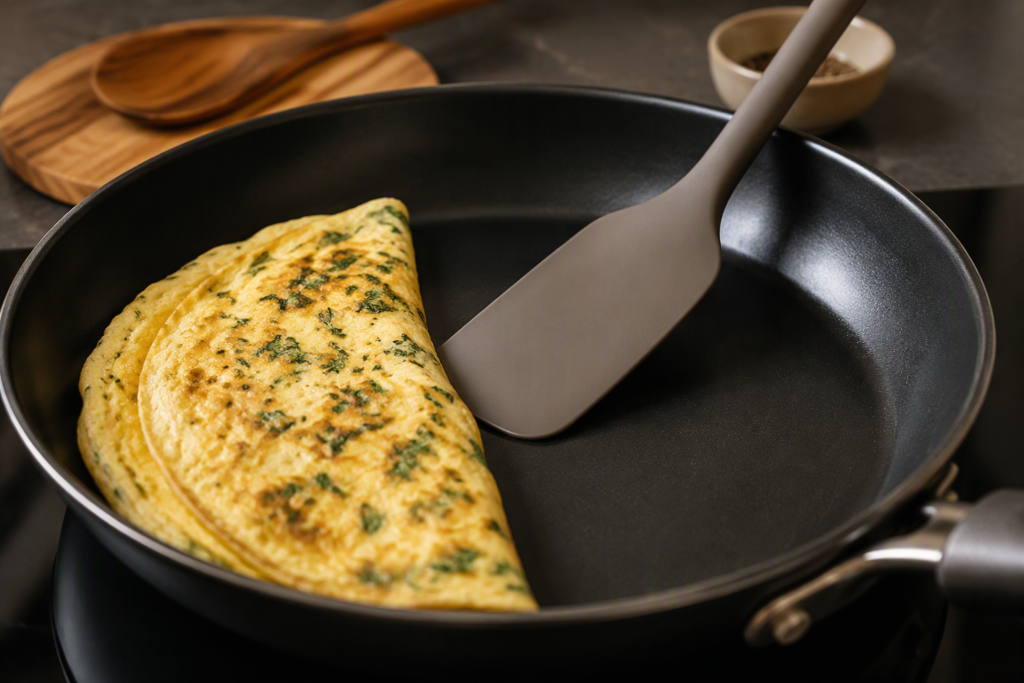
| Spatulas, turners, spoons for non-stick pans | Silicone |
| High-heat cooking tools (grill, searing) | Silicone |
| Baking brushes, basting tools | Silicone |
| Baking molds, cake pans, ice molds | Silicone |
| Mixing bowls, measuring tools, cold prep | PP |
| Storage and organizer trays | PP |
| Stiff scrapers and dough tools | PP or reinforced silicone |
Most successful kitchen lines are mixed: silicone for the heat-and-non-stick items, PP for the value and cold-prep items.
For B2B buyers: what to stock and how to source
From a sourcing perspective, the material question is also a range-planning question:
- Lead with silicone where you can justify a premium price — spatulas, tongs, baking tools. These carry higher margins and align with the “non-toxic, non-stick-safe” demand driving the category.
- Use PP to fill the budget tier and cold-prep slots, so your line covers every price point.
- Certify both: specify FDA and/or LFGB compliance and require test reports, whichever materials you choose.
- Source them together: a manufacturer running both silicone and food-grade PP lines under one roof simplifies QC, packaging and lead times across the whole range.
LEEYUEN runs a 3,000 m² facility in Jiangmen, China with 10+ precision injection and hydraulic compression machines, producing FDA- and LFGB-compliant silicone and PP kitchenware for buyers in 20+ countries. Every order passes three-stage QC (incoming material → in-process inspection → pre-shipment audit) at AQL 2.5, backed by ISO 9001 and BSCI certification.
From the production floor: the reason buyers consolidate materials with one factory is not price — it is consistency. When silicone and PP parts run on the same QC system, color matching, packaging specs and lead times stay aligned, and there is no argument between two suppliers when something goes wrong at the container.
How to tell pure silicone from cheap “silicone”
If you are evaluating samples, use the pinch/twist test: twist the silicone tool between your fingers. Pure food-grade silicone holds its color; filled silicone turns white at the stress point. Cheap filler also shows up as a strong chemical odor on a new product or a waxy “bloom” over time. For a deeper walkthrough of supplier vetting, see our guide on choosing a silicone kitchenware manufacturer.
Sources
- US FDA — 21 CFR 177.2600, Rubber articles intended for repeated use: ecfr.gov
- BfR (German Federal Institute for Risk Assessment) — Recommendation XV, Silicones: bfr.bund.de
- ISO 2859-1 — Sampling procedures for inspection by attributes (AQL): iso.org
FAQ
-
Are silicone utensils better than plastic?For high-heat cooking and non-stick pans, yes — silicone is heat-stable to 230°C, chemically inert, and will not scratch coatings. For cold prep and budget lines, plastic (PP) is cheaper and works well. -
Is silicone or plastic safer for cooking?Food-grade silicone is the safer choice for cooking because it is inert and does not leach even at high heat. Plastic is safe only if it is a food-grade resin (PP or food-grade nylon) and is not overheated or heavily worn. -
Can plastic utensils melt in the pan?PP utensils soften at around 110°C and melt at 160–170°C, so a PP tool left in a hot pan can deform or melt. Nylon resists more heat but can still soften at stovetop temperatures. Silicone is rated to 230°C. -
Is silicone better for non-stick pans?Yes. Silicone is flexible and soft-edged, so it will not scratch non-stick coatings. Rigid plastic or metal edges can damage the coating. -
Which is cheaper to manufacture — silicone or plastic?Plastic (PP) is cheaper per unit in raw material and tooling, so it suits budget ranges. Silicone costs more to produce but supports a higher retail price and a premium market position.