
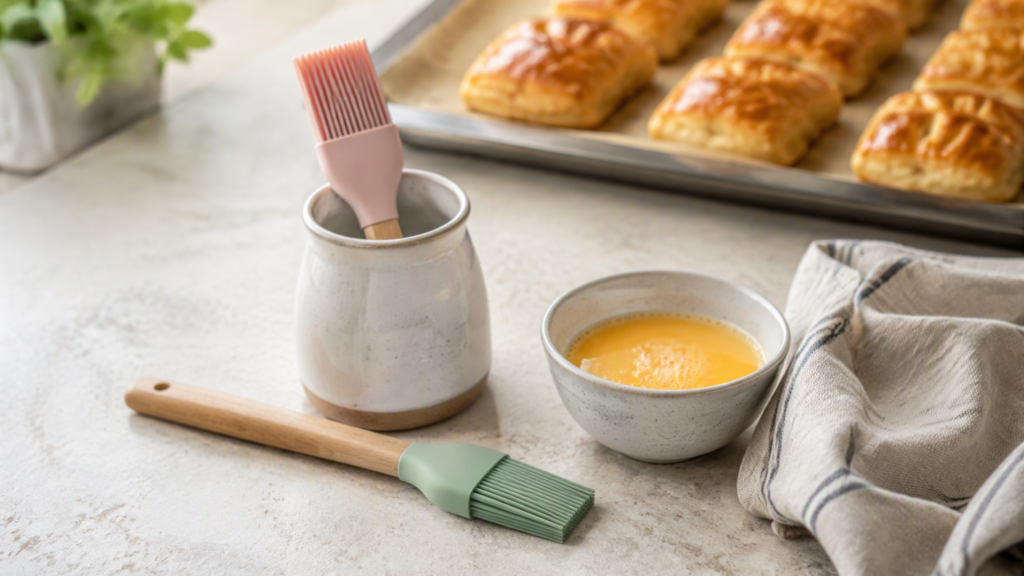
A silicone brush does not shed hairs, because it never had hairs. When one fails, it is almost always one of two things: an inserted bristle block working loose from its socket, or a one-piece head tearing at the base of a bristle. Both are decided at the mould, months before the brush reaches a kitchen. This guide explains what to look at, why pastry work exposes the problem first, and what to specify if you are buying by the thousand.
What “shedding” actually means in a silicone brush
Two constructions, two failure modes
There are only two ways to attach a silicone bristle field to a handle.
Inserted head. A separately moulded bristle block is pressed — sometimes glued — into a socket in the handle or a PP collar. Cheap to tool, and one handle can carry several head shapes. Its failure point is the socket: repeated flexing and hot washing work the block upward until a cluster lifts free, usually as a unit rather than as single bristles.
One-piece moulded head. Bristles and head form in the same cavity, then overmould onto a PP core for stiffness. No socket to work loose, so the failure point moves to each bristle root, where a sharp corner concentrates stress under repeated bending.
Neither is automatically better: a well-made inserted head outlasts a poorly moulded one-piece.
What a root fillet does
Look closely at where a bristle meets the head. A radiused fillet spreads bending stress across a curve; a sharp corner concentrates it on a line. Under a magnifier the difference is obvious, and it is the single most reliable visual predictor of root tearing. If a supplier cannot tell you the fillet radius on their tool, they have not thought about it.

Why silicone brushes hold less liquid — and how design fixes it
Silicone is hydrophobic and has low surface energy: liquid beads and runs off rather than clinging. That is why a plain silicone brush carries less egg wash than boar bristle.
The fix is geometry, not chemistry. Three approaches work:
- Perforations through the bristle face, which trap liquid in the holes by surface tension
- Cup-shaped or channel-shaped bristle cross-sections, which carry liquid in the groove rather than on the surface
- Tighter bristle spacing with a shorter free length, which increases capillary hold at the cost of flexibility
Each has a trade-off: perforations hold more wash but are harder to clean at the rim; tighter spacing carries more liquid but stiffens the brush and leaves visible lines on delicate pastry.
Pastry work is where a bad brush shows first
Egg wash, apricot glaze and simple syrup are the most unforgiving things you can put through a brush: viscous, quick to dry hard, and applied to a surface where a stray fragment is immediately visible. A custard tart has nowhere to hide a loose tuft.
This is why silicone pastry brush complaints cluster around two failures. Home bakers rarely notice a stiff basting brush; they notice a bristle stub in the glaze. A brush used daily for glazing also takes far more washing and hot contact than one used twice a month on a grill.
If pastry is the main job, prioritise root geometry and a seam-free head over bristle softness. If basting is the main job, prioritise handle length and a heat rating that covers the whole tool.
Three checks before you buy
1. Look at the joint, not the bristles
Run a fingernail along the line where the head meets the handle. A one-piece head has no line at all — the silicone continues into the handle or ends in a clean overmould boundary. An inserted head shows a seam, and a seam you can catch a nail in is a seam that will collect wash and eventually lift.
2. Pull one cluster, firmly
Not a gentle tug. Grip a single cluster at the base and pull along the bristle axis. A properly inserted head resists; a marginal one moves perceptibly or shows a pale ring where the block has begun to separate. On a one-piece head, bend the cluster sideways instead and watch the root — whitening that stays after release means the silicone is filled, not pure.

3. Check what the heat rating covers
“230 °C heat resistant” usually describes the silicone. The brush also contains a PP core or collar, and PP softens far below that. A brush rated 230 °C overall, with a plastic collar in the same tool, is a rating that has not been thought through. Ask which component the number applies to, and expect a specific answer.
Silicone vs boar vs nylon
| Silicone | Boar bristle | Nylon | |
|---|---|---|---|
| Holds liquid | Lower, unless the head is perforated or channelled | Highest | High |
| Heat limit | Highest of the three | Low; adhesive at the base softens under high heat | Moderate |
| Shedding risk | Nil in principle; risk is at the joint or root | Real, and the usual complaint | Low where epoxy-set |
| Odour retention | Low | High | Low |
| Delicate pastry | Can leave visible lines | Gentlest | Stiffer than natural |
| Dishwasher | Yes | Not recommended | Yes |
The practical conclusion most guides reach — keep one of each — is correct but incomplete: it treats shedding as a property of natural bristles and lets silicone off the hook. Silicone brushes fail at joints and roots, and that is a manufacturing question you can inspect before paying.
Heat, oil and staining
Three things age a silicone brush faster than heat alone:
- Polymerised oil. Hot fat leaves a film soap will not shift. A baking-soda soak lifts it; abrasive pads only dull the surface and make the next film bond faster.
- Pigment. Turmeric, tomato and berry glazes migrate into the surface layer. Cosmetic, not a reason to replace the brush.
- Dry heat. An empty pan on a high burner runs far hotter than oil-based cooking. Resting a brush against the pan wall during searing damages more brushes than the wash does.
For non-stick pans there is a second reason to prefer a soft edge: research reported in 2026 found that a single scratch in a non-stick coating can release thousands of plastic particles into food (Economic Times, July 2026).
From the production floor
A one-piece head is only as good as its tool. At our Jiangmen factory, running since 2016 across 3,000 m², brush heads are compression-moulded with the bristle field formed in the same cavity — no inserted block, no socket to fail. Heads are post-cured in high-temperature ovens to drive off volatiles, which separates a brush that smells neutral after a month from one that does not, and every bristle root is checked for flash, because a flash line at the root is where a tear begins.

Inspection runs in three stages — incoming material, in-process checks, pre-shipment audit against AQL 2.5. The plant holds ISO 9001 and BSCI, ships to more than 20 countries, and documents food-contact compliance against FDA 21 CFR 177.2600 and LFGB (eCFR). More in our factory profile.
What wholesale buyers should specify
- Head construction — one-piece moulded or inserted block, stated on the spec sheet.
- Root geometry — fillet radius, and whether the tool has been corrected for it.
- Bristle configuration — count, spacing, free length, and whether perforations are required for liquid retention.
- Core and collar — all-silicone, or PP core; if PP, the heat rating must be quoted separately.
- Colour — Pantone-matched, physical swatch approved before production.
- Logo — silk-screen, laser, or debossed into the tool; debossed marks cannot wear off.
- Packaging — hang-tag card, printed sleeve, colour box, or FBA barcode label.
- Compliance file — FDA and LFGB reports naming the batch, not a generic certificate.
Typical lead times: existing samples in 1–2 days, custom samples around 30 days, mass production about 15 days, with pricing tiers at 500, 1,000 and 5,000 pieces. For the wider utensil range, see how to choose a silicone spatula; for bakeware that pairs with a glazing brush, how to use a silicone muffin pan.
FAQ
Why is my silicone brush shedding?
It is not shedding hairs. Either an inserted bristle block is lifting out of its socket, or a one-piece head is tearing at a bristle root where the fillet is too sharp. Both are construction faults, not wear.
Do silicone brushes hold less liquid than boar bristle?
Yes, on a plain head — silicone is hydrophobic and liquid beads off. Perforations, channelled bristles or tighter spacing recover most of the difference. A perforated silicone head can approach natural bristle performance.
Can I use a silicone brush for egg wash?
Yes, and it is the safer choice for hygiene, but a plain silicone head applies a thinner coat than boar. Brush in two light passes rather than one heavy one, and avoid dragging the bristles across delicate pastry.
Is a silicone brush heat resistant enough for grilling?
The silicone is, typically to 230 °C (446 °F). The limiting part is the PP core or collar, which softens well below that. Keep the plastic sections off hot grill bars and out of direct flame.
How do I clean a brush that feels permanently greasy?
Soak in hot water with baking soda for 30 minutes, then wash normally. The film is polymerised fat, not residue — abrasive pads dull the surface and make the next film stick faster.
Is one-piece always better than an inserted head?
No. A well-made inserted head with sufficient depth outlasts a poorly moulded one-piece with a sharp root. Judge the joint and the fillet, not the category.
Sourcing silicone brushes
Leeyuen makes one-piece silicone brushes and brush-and-spatula sets in Jiangmen, with debossed logos, Pantone colour matching and retail-ready packaging. Existing samples ship in 1–2 days, custom samples in about 30 days, and bulk orders run under three-stage QC with AQL 2.5.
Send your head construction, bristle configuration, colour and packaging direction for a factory quotation within 12 hours. Request a wholesale quote, see the one-piece silicone baking brush and the silicone spatula and baking brush set, or browse the silicone spatulas and utensils range.