
Short answer: Silicone cake molds do not release because they are non-stick. They release because the material can be pulled away from the cake a section at a time, and because its surface energy is low enough that very little sticks in the first place. A coated metal pan releases by sliding; a silicone mold releases by peeling. Once you see that difference, the technique, the timing and the buying checklist all change.
Two different kinds of non-stick
A non-stick cake pan and a silicone cake mold are both sold as “non-stick,” and the word hides the fact that they work in opposite ways.
A coated pan is a rigid shape with a low-energy film on top. The cake sits in a form that cannot move, on a surface that repels it. Release happens when the cake slides along that surface as a single rigid piece. That is why the standard instruction is to invert the pan and let gravity do the work.
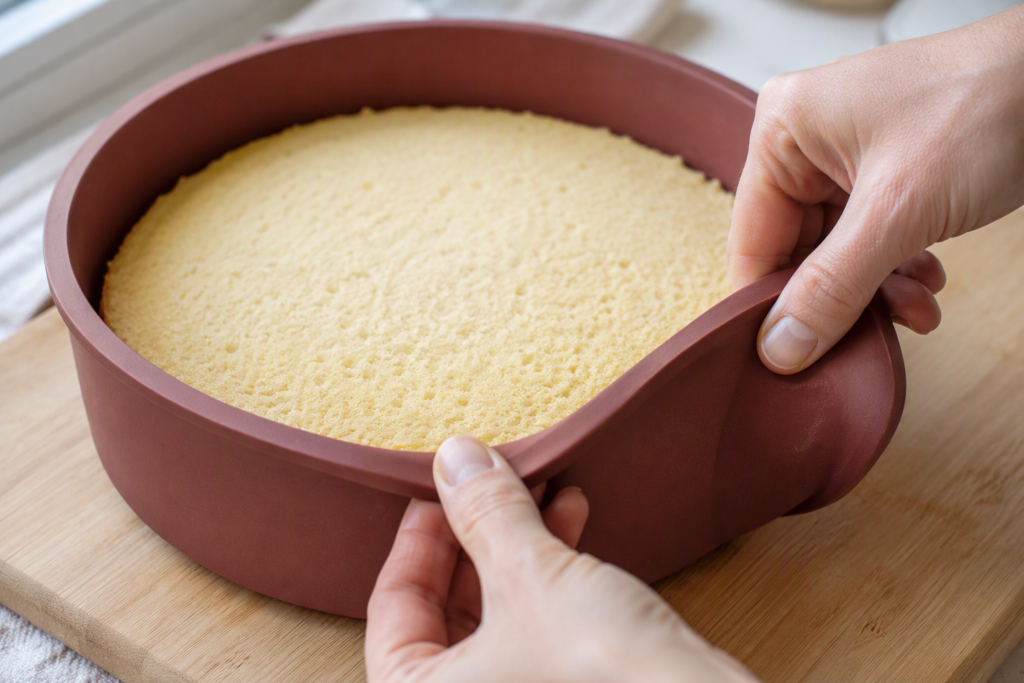
A silicone mold is a low-energy surface on a form that flexes. The cake sits in a shape that can be opened. Release happens when you peel the wall away from the cake, around the perimeter, before the cake ever has to move as a whole.
The practical consequence is simple and almost never stated: a silicone cake mold should not be inverted while the cake is still inside it. If you flip an unsupported silicone mold, the cake’s own weight presses it against the base, and the walls collapse inward around it. You have moved from peeling to crushing.
This is the single most common reason a cake breaks coming out of a silicone mold, and it has nothing to do with greasing, batter or bake time.
What actually holds the cake in
Three forces keep a baked cake against the mold wall, and only one of them is adhesion.
Surface energy. Silicone has a low surface energy, which is the same property that makes it resist staining. A low-energy surface gives the cake little to bond to. This is real, but it is the smallest of the three.
Mechanical interference. As the cake cools, it contracts. As the mold cools, it contracts too, but the mold is wrapped around the outside of the cake, and a contracting ring closes on whatever is inside it. A fully cooled silicone mold grips harder than a warm one. This is why “let it cool completely” is the wrong instruction for silicone, even though it is the right instruction for metal.
Shape lock. A cavity with re-entrant geometry — a shape that is wider somewhere below the rim than at the rim — cannot be released by lifting. It has to be peeled. Most novelty and character molds have some degree of this, and it is why they demand more flex than a plain round pan.
None of these forces is strong. Together they are enough that technique decides the outcome.
When to unmold
The window is narrower than most recipes suggest.
Too early, and the cake has not finished setting. Starch has not fully retrograded, the crumb is still weak, and any peel force tears it. A cake that breaks at the base while still hot was unmolded too soon, not handled too roughly.
Too late, and the contracting mold has closed onto a cake that has also contracted and become more brittle. The cake is now strong enough to resist peeling but stiff enough to crack instead of flex.
The usable window is when the mold is still warm to the touch but no longer hot — warm enough that the silicone is soft and compliant, cool enough that the crumb holds together. For most cakes that is somewhere between ten and twenty minutes out of the oven, but the touch test is a better guide than a timer, because a dense batter holds heat far longer than a sponge.
If you are working with a shaped mold, add a few minutes. The thick silicone at the points and corners holds heat, and the cake there sets last. Unmolding on the schedule of the centre means the point has not set.
Flex the wall, one section at a time
The motion is not a push. It is a peel.
Work around the perimeter and press the wall outward and slightly downward, away from the cake, a few centimetres at a time. You are trying to break the contact line progressively, not to open the whole mold at once. Each section you release stays released, because the silicone does not spring back against the cake.
On a round mold, start anywhere and go round. On a shaped mold, start at the widest, gentlest section and finish at the tightest point, so that by the time you reach the point most of the cake is already free and the point only has to clear its own small contact area.
Then place your hand or a board over the open face and invert in one motion. Because the walls are already released, the cake is no longer being dragged — it is being transferred.
The reason people tear cakes is almost always that they skip the peel and go straight to the flip. The cake is still bonded around its full perimeter, and the entire release load lands on the weakest part of the crumb.
Where the shape works against you
Every cavity has one point that fails first, and in a shaped mold it is predictable.
At a sharp corner, two things happen at once. The local wall is thinner, so there is less material to carry heat and less to resist deformation when the silicone softens in the oven. And the geometry changes direction abruptly, which means the peel force has to act in two directions at once instead of one.
The rule our tooling team works to is that the corner radius should not be smaller than the local wall thickness. Below that ratio, the corner behaves like a hinge: it folds slightly under its own weight while the cake is setting, and the point arrives rounded rather than sharp.
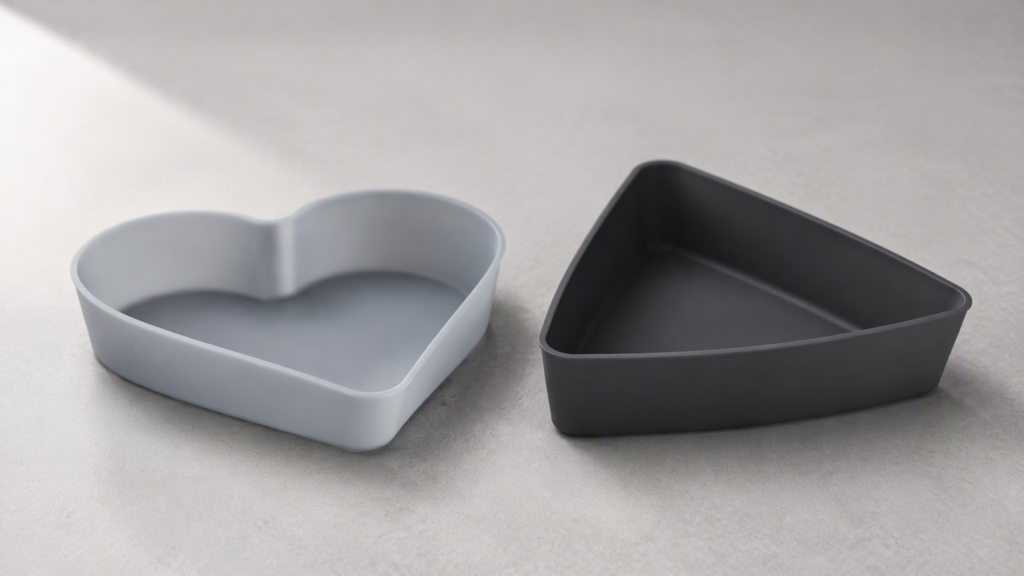
In a heart-shaped silicone cake mold the two lobes are easy — generous radii, shallow walls, uniform thickness. The bottom point is the whole design problem. In an 8-cavity triangle silicone cake mold it is all three apexes, and the reason we tool a visible taper into each one is that a point with no draft has to be peeled against rather than along.
If you are comparing molds and cannot see the corner, ask for the radius at the tightest point. A supplier who can answer that question in numbers is a supplier who tooled the corner deliberately.
Why the crust looks different
A cake baked in silicone has a paler, softer side wall than the same batter baked in aluminium. This is not a defect and it is not a grade problem — it is the material doing its job.
Aluminium conducts heat quickly, so the batter in contact with the pan reaches browning temperature early and stays there. That produces a browned, slightly firm surface layer that follows the pan’s shape.
Silicone conducts heat slowly. The batter at the wall comes up to temperature more gradually and never reaches the temperature that drives browning to the same degree. The result is a wall that is tender rather than set, with no visible crust line.
For a frosted cake this is an advantage: no dark ring under the icing, no dry edge to trim. For an unfrosted dessert where the surface is the product, it is a constraint — and the usual fix is not a higher oven temperature but a longer bake at the temperature you already use, so the interior catches up without the exterior overbaking.
There is a second-order effect worth knowing. Because silicone insulates, the base of a mold heats more slowly than the base of a metal pan. A recipe written for metal and baked in silicone at the same temperature and time will usually come out with a properly set top and an underdone base. Add time before you add heat.
Why a new mold smells, and why that matters when buying
A newly unboxed silicone mold sometimes has a faint odour on its first bake. Buyers treat this as a sign of cheap material. It is usually a sign of an incomplete process step.
Silicone is vulcanised, and vulcanisation leaves residual volatile compounds in the sheet. Food-grade production adds a post-cure — a second, prolonged heat cycle that drives those volatiles out before the mold ships. Post-curing costs oven time and is easy to shorten. A mold that smells strongly on first use, or smokes slightly, was probably not post-cured long enough.
This is one of the few quality differences a buyer can detect without a lab, which makes it worth asking about directly. “Is this post-cured, and for how long” is a question that separates suppliers who control the process from suppliers who buy sheet and cut it.

What to specify before you buy
If you are sourcing silicone cake molds rather than buying one, four specifications determine whether the mold will release well in your customers’ kitchens.
Wall thickness and its distribution. Uniform walls bake evenly. What matters more is the thickness behind the tightest corner, because that is where the mold either holds its shape or rounds over.
The critical corner radius. Ask for it as a number relative to wall thickness. This is the specification that most distinguishes a designed mold from a copied one.
Draft on shaped cavities. Round cavities need almost none. Points and tight curves need a positive taper, and it should be visible on the sample, not just claimed on the drawing.
Post-cure. Ask for the cycle, not just “food grade.” Then verify with your nose on the first sample bake.
Material should be 100% food-grade silicone rated across the full range you intend to sell into — ours runs −40 °C to 230 °C with a PP frame where the design needs rigidity. Ask for FDA 21 CFR 177.2600 or LFGB reports covering the production batch. The full silicone baking molds range is organised by tooling family, which is a more useful way to build a range than by product name, and if you are converting recipes between mold types, the conversion logic in our guide to using a silicone muffin pan applies to any cavity format.
From the production floor
We hydraulically compression mould our cake molds and post-cure them at high temperature before packing. The post-cure is the step that most often gets shortened elsewhere, and it is the one that shows up first in a customer complaint about smell.
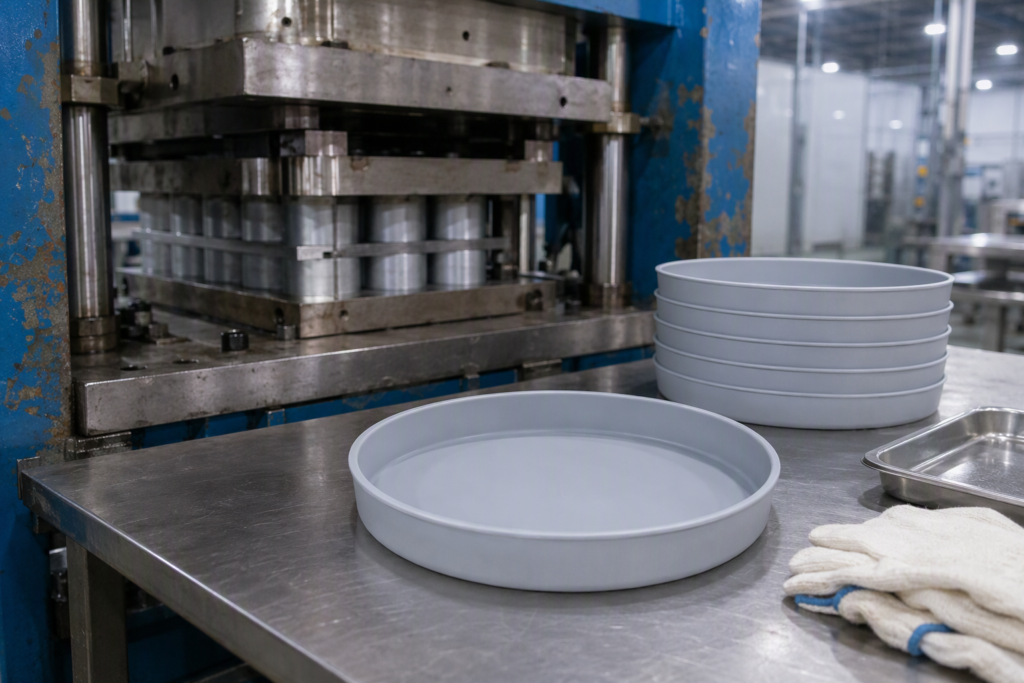
For a new shape — a round set, a small square, or something entirely new — the path from 3D drawing to sample runs about 10 days. Stock configurations ship as samples in 1–2 days. Production is inspected at three stages and sampled to AQL 2.5 before shipment, with volume pricing at 500, 1,000 and 5,000 pieces.
Send us a drawing and we will tell you where the release will fail before a tool is cut. That conversation is cheaper than a re-tool.
FAQ
Do silicone cake molds need greasing?
Usually not, and greasing can work against you. Silicone’s low surface energy already limits bonding, and an uneven oil film creates patches that grab differently from the rest of the surface. Grease only if the batter is very high in sugar or the mold has a deep re-entrant shape that has to be peeled a long way.
Why did my cake tear at the bottom?
Almost always because the mold was inverted before the walls were released. The cake’s weight pressed it against the base while the walls closed in. Peel the perimeter first, then invert.
Should I let the cake cool completely before removing it from a silicone mold?
No. A fully cooled mold has contracted onto a cake that has also contracted and stiffened. Unmold while the mold is still warm but no longer hot, so the silicone is compliant and the crumb still holds.
Can I use silicone cake molds in a water bath?
es, and they are often the better choice for one, because the flexible wall tolerates the temperature swing. Set the mold inside a larger pan and bring the water up the outside wall — not over the rim.
Why does my heart-shaped cake come out with a rounded point?
The corner radius at the point is too small relative to the wall thickness there, so the corner folds slightly while the cake sets. This is a tooling issue, not a baking one, and no amount of greasing fixes it.
How long do silicone cake molds last?
Indefinitely at normal baking temperatures if they are not cut, not used on a direct burner, and not washed with abrasives. The failure mode is mechanical damage, not material degradation — which is why the weak points are the thin sections at sharp corners.
Talk to us before the tool is cut
If you are developing a shaped mold and want to know where it will fail before you commit to tooling, send us the drawing. We will come back with the corner radii, draft and wall distribution we would tool at, and quote against your volume tier.